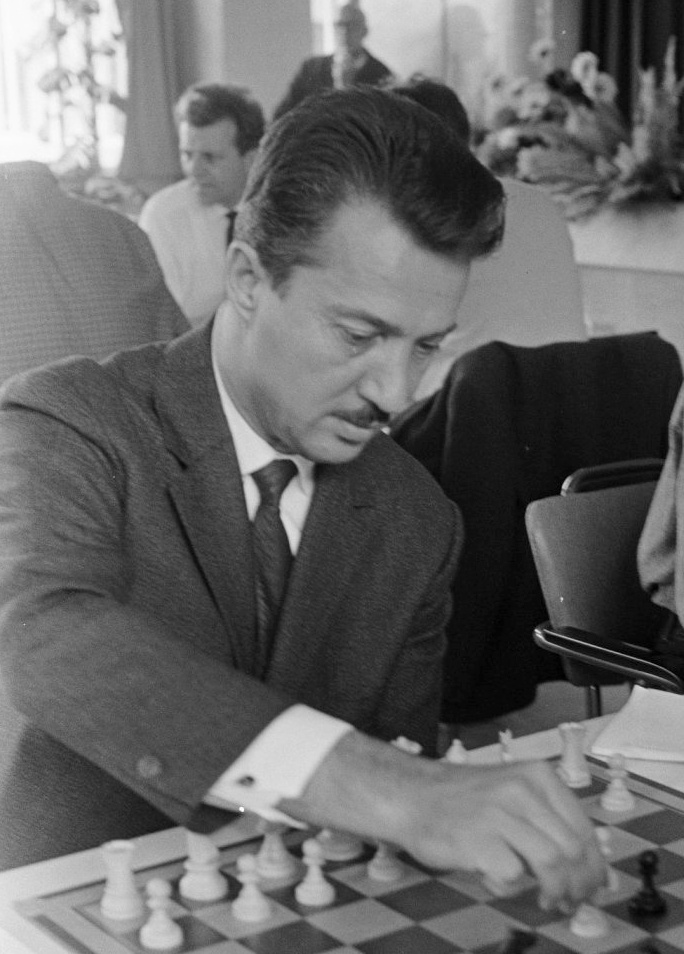
foto · Eric Koch / Anefo · CC BY-SA 3.0 NL · Wikimedia Commons
Portrait · GM
Svetozar
Gligorić
Eleven Yugoslav titles and games against world champions that became part of chess's essential reading.
Years
1923-2012
Title
GM
City
Belgrade
FIDE ID
900400
Rating peak
2600 (FIDE 1971, 15th in the world)
Games in the archive
3
Svetozar Gligoric (1923–2012), affectionately known as Gliga, was one of the leading players of the 1950s and 1960s. Born in Belgrade, he became a grandmaster in 1951 and won eleven Yugoslav championships. As a journalist and author, he brought elite chess closer to readers by explaining the ideas behind the moves.
At the 1959 Candidates Tournament in Yugoslavia, Gligorić had White against sixteen-year-old Bobby Fischer, in the first of our three selected encounters.
Svetozar Gligorić - Robert James Fischer · Candidates Tournament, Bled/Zagreb/Belgrade, 1959
8
7
6
5
4
3
2
a1
b
c
d
e
f
g
h
Move · · starting position
0/86 · ← → ↑ ↓
0/86 · ← → ↑ ↓
?! inaccuracy? mistake?? blunderRight-click: arrows and circles
Move listSAN
1.
2.
3.
4.
5.
6.
7.
8.
9.
10.
11.
12.
13.
14.
15.
16.
17.
18.
19.
20.
21.
22.
23.
24.
25.
26.
27.
28.
29.
30.
31.
32.
33.
34.
35.
36.
37.
38.
39.
40.
41.
42.
43.
Gligoric–Fischer, Candidates 1959: 17.Ndxb5 and 18.Nxb5 open the queenside; later, active white rooks and advancing pawns carry on the work.
At the 1959 Candidates Tournament in Yugoslavia, Gligoric had White against sixteen-year-old Bobby Fischer. In a Najdorf Sicilian, both players castle queenside. Gligoric then uses his knights to open that very wing.
Four years later, at the Piatigorsky Cup in Los Angeles, Gligorić faced Tigran Petrosian, who had become world champion that year. Gligorić has White.
Svetozar Gligorić - Tigran Petrosian · Piatigorsky Cup, Los Angeles, 1963
8
7
6
5
4
3
2
a1
b
c
d
e
f
g
h
Move · · starting position
0/85 · ← → ↑ ↓
0/85 · ← → ↑ ↓
?! inaccuracy? mistake?? blunderRight-click: arrows and circles
Move listSAN
1.
2.
3.
4.
5.
6.
7.
8.
9.
10.
11.
12.
13.
14.
15.
16.
17.
18.
19.
20.
21.
22.
23.
24.
25.
26.
27.
28.
29.
30.
31.
32.
33.
34.
35.
36.
37.
38.
39.
40.
41.
42.
43.
Gligoric–Petrosian, Los Angeles 1963: kingside pressure develops into an endgame where White's active rook collects pawns.
The game does not end in a quick mate. After the queens come off, Gligoric's rooks stay active and his f- and h-pawns create fresh problems. Four years later, at the Piatigorsky Cup in Los Angeles, he faced Tigran Petrosian, who had become world champion that year. This time the opening is a Ruy Lopez.
Gligorić and Petrosian met again in Zagreb in 1970, this time with Gligorić playing Black.
Tigran Petrosian - Svetozar Gligorić · Rovinj/Zagreb, 1970
1
2
3
4
5
6
7
h8
g
f
e
d
c
b
a
Move · · starting position
0/66 · ← → ↑ ↓
0/66 · ← → ↑ ↓
?! inaccuracy? mistake?? blunderRight-click: arrows and circles
Move listSAN
1.
2.
3.
4.
5.
6.
7.
8.
9.
10.
11.
12.
13.
14.
15.
16.
17.
18.
19.
20.
21.
22.
23.
24.
25.
26.
27.
28.
29.
30.
31.
32.
33.
Petrosian–Gligoric, Zagreb 1970: Black advances his kingside pawns and opens lines for bishops, queen and rooks.
Gligoric also made a significant contribution to the King's Indian Defence. A system with White's bishop on e3 bears his name, while with Black he demonstrated the opening's attacking possibilities. Against Petrosian in Zagreb in 1970, Black's pawns head towards White's king while the centre remains closed.
Follow the g- and h-pawns in the final game: their advance changes the squares available to White's king and gives Black's pieces new targets. Such ideas explain why Gligoric's games are still studied. Alongside his tournament achievements, he left books, commentary and, in later life, music - a rich life whose chess remains easy to explore at the board.