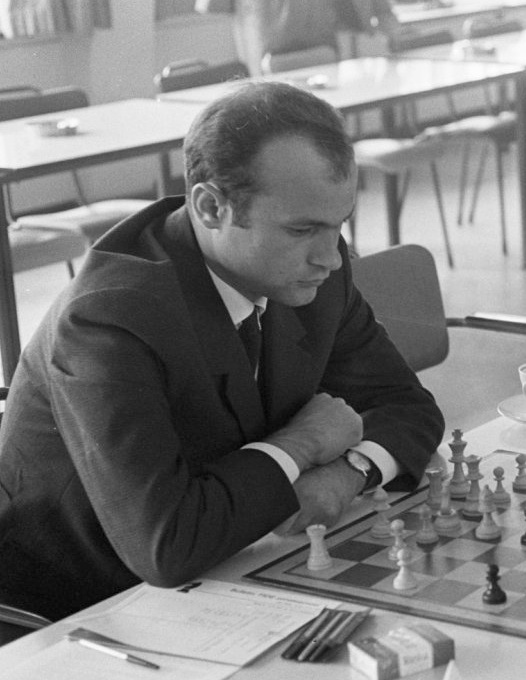
foto · Eric Koch / Anefo · CC BY-SA 3.0 NL · Wikimedia Commons
Portrait · GM (grandmaster)
Dragoljub
Velimirović
The attacking player behind one of the sharpest Sicilian variations. His sacrifices still invite a closer look.
Years
1942-2014
Title
GM (grandmaster)
City
Belgrade
FIDE ID
900079
Rating peak
2575 (Jan 1986, 20th in the world)
Games in the archive
1
Dragoljub Velimirovic (1942–2014) learned chess from his mother Jovanka, a Yugoslav women's champion. Born in Valjevo, he developed a strongly attacking style and earned the nickname “the Yugoslav Tal”. His games are full of sacrifices, with concrete ideas behind them: an open file, an active piece or a king short of shelter.
At the 1965 Yugoslav Championship, Velimirović has White against Jovan Sofrevski. The game predates his grandmaster title.
Dragoljub Velimirović - Jovan Sofrevski · Yugoslav Championship, 1965
8
7
6
5
4
3
2
a1
b
c
d
e
f
g
h
Move · · starting position
0/47 · ← → ↑ ↓
0/47 · ← → ↑ ↓
?! inaccuracy? mistake?? blunderRight-click: arrows and circles
Move listSAN
1.
2.
3.
4.
5.
6.
7.
8.
9.
10.
11.
12.
13.
14.
15.
16.
17.
18.
19.
20.
21.
22.
23.
24.
Velimirovic–Sofrevski, 1965: the sacrifice 14.Nf5 clears routes for pawns and pieces towards Black's king.
Against Jovan Sofrevski at the 1965 Yugoslav Championship, White castles queenside and advances his g-pawn. With 14.Nf5, Velimirovic offers a knight to open the centre. If Black accepts, White's other knight gains the d5-square.
This setup is associated with the Velimirovic Attack in the Sicilian Defence: bishops on c4 and e3, queen on e2, queenside castling and advancing kingside pawns. The plan is easy to recognise, but choosing the moment to sacrifice takes precise calculation.
Velimirović and Ljubomir Ljubojević, two players remembered for their attacking chess, met in Umag in 1972. Velimirović had White.
Dragoljub Velimirović - Ljubomir Ljubojević · Yugoslav Championship, Umag, 1972
8
7
6
5
4
3
2
a1
b
c
d
e
f
g
h
Move · · starting position
0/53 · ← → ↑ ↓
0/53 · ← → ↑ ↓
?! inaccuracy? mistake?? blunderRight-click: arrows and circles
Move listSAN
1.
2.
3.
4.
5.
6.
7.
8.
9.
10.
11.
12.
13.
14.
15.
16.
17.
18.
19.
20.
21.
22.
23.
24.
25.
26.
27.
Velimirovic–Ljubojevic, Umag 1972: a knight on d5 and a rook sacrifice on e6 transform the struggle in the centre.
Against Ljubomir Ljubojevic in Umag in 1972 comes an even more striking idea: 12.Nd5, followed by 14.Rxe6+. White opens the centre while Black's king is still on e8. After the rook sacrifice is accepted, a knight reaches e6 and the queen joins in with a check on h5.
Interestingly, this game continues after the queen exchange. Velimirovic's knight reaches f6 and his h-pawn advances with support. The opening attack develops into a different kind of pressure: a good sacrifice can leave an advantage that lasts after the immediate checks have ended.
That same year in Ohrid, Velimirović had Black against Rafael Vaganian, giving us a chance to see him from the other side of the board.
Rafael Vaganian - Dragoljub Velimirović · Ohrid, 1972
1
2
3
4
5
6
7
h8
g
f
e
d
c
b
a
Move · · starting position
0/64 · ← → ↑ ↓
0/64 · ← → ↑ ↓
?! inaccuracy? mistake?? blunderRight-click: arrows and circles
Move listSAN
1.
2.
3.
4.
5.
6.
7.
8.
9.
10.
11.
12.
13.
14.
15.
16.
17.
18.
19.
20.
21.
22.
23.
24.
25.
26.
27.
28.
29.
30.
31.
32.
Vaganian–Velimirovic, Ohrid 1972: active black bishops, queen and rook create threats against the king in the centre.
Velimirovic could create such play with Black too. Against Rafael Vaganian in Ohrid in 1972, both sides collect material as Black's bishops and queen become increasingly active. White's king soon has to leave its shelter.
A grandmaster from 1973, Velimirovic won the Yugoslav Championship three times and earned team and individual silver at the 1974 Nice Olympiad. His name lives on in opening theory and in these games. A little curiosity is enough to enjoy them; a board nearby helps when you want to work out the continuations.