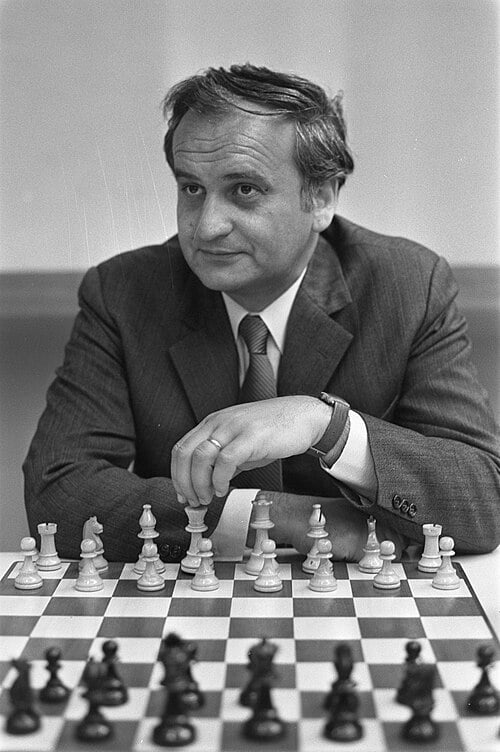
foto · Rob Croes / Anefo · CC0 1.0 · Wikimedia Commons
Portrait · GM
Borislav
Ivkov
The first World Junior Champion, a long-serving international and a grandmaster whose wins span generations.
Years
1933-2022
Title
GM
City
Belgrade
FIDE ID
900141
Rating peak
2560 (FIDE, January 1971; 28th in the world)
Games in the archive
1
Borislav Ivkov (1933–2022), known as Bora, won the inaugural World Junior Championship in England in 1951, aged seventeen. The Belgrade player earned a unique place in the history of the new event. In the years that followed, he became a grandmaster and a key member of Yugoslavia's national team.
In Belgrade in 1954, Ivkov had White against Tigran Petrosian, nine years before Petrosian won the world title.
Borislav Ivkov - Tigran Petrosian · Belgrade, 1954
8
7
6
5
4
3
2
a1
b
c
d
e
f
g
h
Move · · starting position
0/87 · ← → ↑ ↓
0/87 · ← → ↑ ↓
?! inaccuracy? mistake?? blunderRight-click: arrows and circles
Move listSAN
1.
2.
3.
4.
5.
6.
7.
8.
9.
10.
11.
12.
13.
14.
15.
16.
17.
18.
19.
20.
21.
22.
23.
24.
25.
26.
27.
28.
29.
30.
31.
32.
33.
34.
35.
36.
37.
38.
39.
40.
41.
42.
43.
44.
Ivkov–Petrosian, Belgrade 1954: after the major pieces are exchanged, White's king seeks a route to Black's weak pawns.
With White against Tigran Petrosian in Belgrade in 1954, Ivkov enters a Sicilian Defence. The kings castle on opposite sides, but exchanges gradually quieten the game. Its closing stages show the value of an active king.
Watch the white king's journey: first towards the kingside, then back through e2 and d3 to c4. While the bishop maintains pressure, the king changes wings. This is a fine example of an endgame with a clear plan even without immediate mating threats.
The encounter with Bobby Fischer in Havana in 1965 had an unusual setting: Fischer played from New York, with moves relayed by teletype. Ivkov had Black.
Robert James Fischer - Borislav Ivkov · Capablanca Memorial, Havana, 1965
1
2
3
4
5
6
7
h8
g
f
e
d
c
b
a
Move · · starting position
0/106 · ← → ↑ ↓
0/106 · ← → ↑ ↓
?! inaccuracy? mistake?? blunderRight-click: arrows and circles
Move listSAN
1.
2.
3.
4.
5.
6.
7.
8.
9.
10.
11.
12.
13.
14.
15.
16.
17.
18.
19.
20.
21.
22.
23.
24.
25.
26.
27.
28.
29.
30.
31.
32.
33.
34.
35.
36.
37.
38.
39.
40.
41.
42.
43.
44.
45.
46.
47.
48.
49.
50.
51.
52.
53.
Fischer–Ivkov, Havana 1965: Black's passed d-pawn reaches d2, decisively tying down White's pieces.
Ivkov played in the 1965 Candidates matches for the world title. That year, he also beat Bobby Fischer with Black in Havana under unusual circumstances: Fischer played from New York, with moves relayed by teletype. On the board, a Ruy Lopez led to a long struggle over the centre.
In the endgame against Fischer, look at 44...d2. White must give up his bishop for the pawn, leaving Ivkov with a knight against pawns. Much of the groundwork was laid earlier, when Black's rook first entered on d3.
In Caracas in 1970, Ivkov faced Anatoly Karpov, another future world champion. This time Ivkov has White.
Borislav Ivkov - Anatoly Karpov · Caracas, 1970
8
7
6
5
4
3
2
a1
b
c
d
e
f
g
h
Move · · starting position
0/57 · ← → ↑ ↓
0/57 · ← → ↑ ↓
?! inaccuracy? mistake?? blunderRight-click: arrows and circles
Move listSAN
1.
2.
3.
4.
5.
6.
7.
8.
9.
10.
11.
12.
13.
14.
15.
16.
17.
18.
19.
20.
21.
22.
23.
24.
25.
26.
27.
28.
29.
Ivkov–Karpov, Caracas 1970: queen, bishop, knights and rooks combine to draw Black's king into the centre.
Against Anatoly Karpov in Caracas in 1970, Ivkov launches a more direct attack. Queen and bishop target the kingside as the knights join from the centre. After 24.Nf5, accepting the sacrifice opens the queen's path to g8.
From junior gold to Candidates matches and numerous Olympiad appearances, Ivkov spent many years among the world's leading players. These games give a good sample of his versatility: an active king, a dangerous passed pawn and a coordinated piece attack. All three ideas have a place in the games we play today.