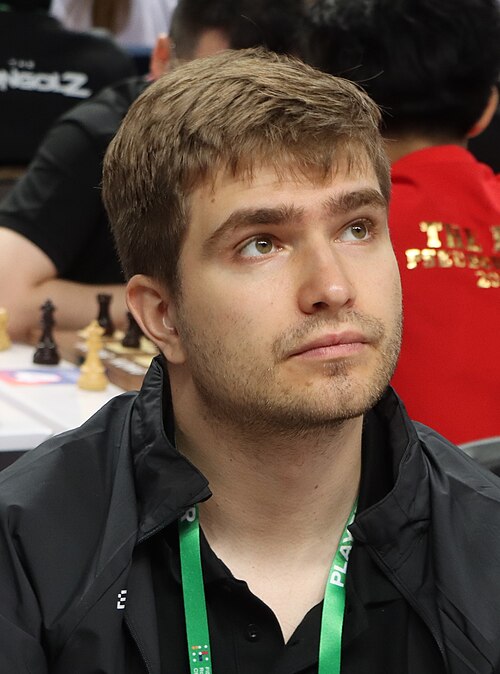
foto · Yunfan Zhao / Lichess · CC BY-SA 4.0 · Wikimedia Commons
Portrait · GM
Aleksej
Sarana
The 2023 European champion and a team gold medallist with Serbia, with an eye for active play in attacks and endgames alike.
Years
2000
Title
GM
City
Moscow
FIDE ID
24133795
Rating peak
2717 (July 2024)
Games in the archive
1
Alexey Sarana was born in Moscow in 2000 and has represented Serbia since April 2023. Later that year, he was part of the Serbian team that won the European Team Championship in Budva.
To explore his play, we have selected encounters from the World Cup, UzChess Cup and Olympiad.
At the 2023 World Cup in Baku, Sarana met Wesley So in round four. This is the first game of their match, with Sarana playing Black.
Wesley So - Alexey Sarana · World Cup 2023, Baku (round 4), 2023.08.09
1
2
3
4
5
6
7
h8
g
f
e
d
c
b
a
Move · · starting position
0/68 · ← → ↑ ↓
0/68 · ← → ↑ ↓
?! inaccuracy? mistake?? blunderRight-click: arrows and circles
Move listSAN
1.
2.
3.
4.
5.
6.
7.
8.
9.
10.
11.
12.
13.
14.
15.
16.
17.
18.
19.
20.
21.
22.
23.
24.
25.
26.
27.
28.
29.
30.
31.
32.
33.
34.
So–Sarana, World Cup 2023: the final move, 34...d3, leaves White struggling with pawns on d3 and g2.
Sarana won the individual European title in Vrnjačka Banja in March 2023, while still playing under the FIDE flag. His transfer to the Serbian federation was confirmed the following month.
At the World Cup in Baku that summer, he met Wesley So in round four. In their first game, Sarana used Black’s central play and advancing kingside pawns to create threats far apart on the board. The final position shows how difficult those threats can be to handle together.
At the 2024 UzChess Cup, Sarana had White against Shakhriyar Mamedyarov, in a tournament setting rather than the knockout format of Baku.
Alexey Sarana - Shakhriyar Mamedyarov · UzChess Cup Masters, Tashkent, 2024.06.09
8
7
6
5
4
3
2
a1
b
c
d
e
f
g
h
Move · · starting position
0/137 · ← → ↑ ↓
0/137 · ← → ↑ ↓
?! inaccuracy? mistake?? blunderRight-click: arrows and circles
Move listSAN
1.
2.
3.
4.
5.
6.
7.
8.
9.
10.
11.
12.
13.
14.
15.
16.
17.
18.
19.
20.
21.
22.
23.
24.
25.
26.
27.
28.
29.
30.
31.
32.
33.
34.
35.
36.
37.
38.
39.
40.
41.
42.
43.
44.
45.
46.
47.
48.
49.
50.
51.
52.
53.
54.
55.
56.
57.
58.
59.
60.
61.
62.
63.
64.
65.
66.
67.
68.
69.
Sarana–Mamedyarov, UzChess Cup 2024: an active king, bishops against a rook and a pawn race in which both sides make a new queen.
For a change of pace, try his game against Shakhriyar Mamedyarov at the 2024 UzChess Cup. A complex middlegame leads to an unusual contest between White’s bishops and Black’s rook.
Sarana brings his king into play, creates fresh threats and reaches a pawn race. The game lasts 69 moves, and it rewards attention right to the end: both players manage to promote a pawn to a queen.
Our third game comes from the 2024 Budapest Olympiad, where Sarana had White against Brazil’s Alexandr Fier.
Alexey Sarana - Alexandr Fier · Chess Olympiad, Budapest (round 5), 2024.09.15
8
7
6
5
4
3
2
a1
b
c
d
e
f
g
h
Move · · starting position
0/97 · ← → ↑ ↓
0/97 · ← → ↑ ↓
?! inaccuracy? mistake?? blunderRight-click: arrows and circles
Move listSAN
1.
2.
3.
4.
5.
6.
7.
8.
9.
10.
11.
12.
13.
14.
15.
16.
17.
18.
19.
20.
21.
22.
23.
24.
25.
26.
27.
28.
29.
30.
31.
32.
33.
34.
35.
36.
37.
38.
39.
40.
41.
42.
43.
44.
45.
46.
47.
48.
49.
Sarana–Fier, Olympiad 2024: 42.Bxg7 accelerates the attack while White’s b-pawn creates an additional threat.
Against Alexandr Fier at the 2024 Budapest Olympiad, threats develop on both wings. Sarana advances his pawns before the queens, rooks and bishops join a sharp struggle.
42.Bxg7 starts a new phase of the attack. Keep an eye beyond the kings, though: White’s b-pawn, which reaches b6 near the end, also demands Black’s attention.
From team gold in Budva to the Budapest Olympiad, Sarana has made a significant contribution to Serbia’s national team. His games also offer plenty to learn from.
Try this with the three games here: pause before a pawn advances and check which pieces support it. That cooperation often explains why a seemingly modest move changes the course of the game.