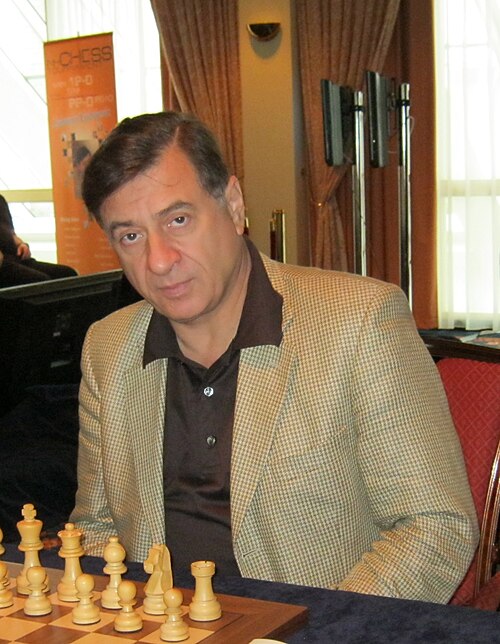
foto · Stefan64 · CC BY-SA 3.0 · Wikimedia Commons
Portrait · GM (grandmaster)
Ljubomir
Ljubojević
The world's third-ranked player in 1983, whose games combine bold attacking ideas with serious calculation.
Years
1950
Title
GM (grandmaster)
City
Užice
FIDE ID
900010
Rating peak
2645 (Jan 1983, 3rd in the world)
Games in the archive
1
Ljubomir Ljubojevic, born in Užice in 1950, belongs among the great names of Yugoslav chess. In 1983 he reached third place in the world rankings. His play is especially enjoyable when he takes the initiative: every move asks his opponent a fresh question.
In Malaga in 1971, the year he became a grandmaster, Ljubojević had White against Kenneth Rogoff, later known for his work as an economist.
Ljubomir Ljubojević - Kenneth Rogoff · Malaga, 1971
8
7
6
5
4
3
2
a1
b
c
d
e
f
g
h
Move · · starting position
0/57 · ← → ↑ ↓
0/57 · ← → ↑ ↓
?! inaccuracy? mistake?? blunderRight-click: arrows and circles
Move listSAN
1.
2.
3.
4.
5.
6.
7.
8.
9.
10.
11.
12.
13.
14.
15.
16.
17.
18.
19.
20.
21.
22.
23.
24.
25.
26.
27.
28.
29.
Ljubojevic–Rogoff, Malaga 1971: the queen travels through h5 to capture the rook on h8, while White doubles rooks on the d-file.
He became a grandmaster in 1971. That year also brought this game in Malaga against Kenneth Rogoff, later a well-known economist. Ljubojevic sends his queen to h5 on move nine. The early queen move is part of a concrete plan, with the other pieces quickly joining in.
After taking the rook, White must also care for his own king. Rogoff creates counterthreats with queen and bishop, so Ljubojevic proceeds carefully. This game shows both sides of attacking chess: making threats and calculating the opponent's resources.
In Teesside in 1972, Ljubojević faced Ulf Andersson, known for his solid positional play. Ljubojević has White.
Ljubomir Ljubojević - Ulf Andersson · Teesside, 1972
8
7
6
5
4
3
2
a1
b
c
d
e
f
g
h
Move · · starting position
0/57 · ← → ↑ ↓
0/57 · ← → ↑ ↓
?! inaccuracy? mistake?? blunderRight-click: arrows and circles
Move listSAN
1.
2.
3.
4.
5.
6.
7.
8.
9.
10.
11.
12.
13.
14.
15.
16.
17.
18.
19.
20.
21.
22.
23.
24.
25.
26.
27.
28.
29.
Ljubojevic–Andersson, Teesside 1972: an active queen and advancing pawns open the game, with 29.Nxd5 consolidating White's material advantage.
At Teesside in 1972, his opponent was Ulf Andersson, known for his solid positional play. In a French Defence, Ljubojevic sends his queen to g4 and h5 before advancing his pawns. White's king loses the right to castle, so the attack needs firm support.
Watch White's rook too: it travels from h1 to h2, then to g2 to shield the king from a check. Attacking games contain many such defensive moves. Only after securing his own king can White's knight capture on d5.
At Turin in 1982, Ljubojević faced former world champion Boris Spassky, during the years when he regularly competed at the highest level.
Ljubomir Ljubojević - Boris Spassky · Turin, 1982
8
7
6
5
4
3
2
a1
b
c
d
e
f
g
h
Move · · starting position
0/59 · ← → ↑ ↓
0/59 · ← → ↑ ↓
?! inaccuracy? mistake?? blunderRight-click: arrows and circles
Move listSAN
1.
2.
3.
4.
5.
6.
7.
8.
9.
10.
11.
12.
13.
14.
15.
16.
17.
18.
19.
20.
21.
22.
23.
24.
25.
26.
27.
28.
29.
30.
Ljubojevic–Spassky, Turin 1982: Black sacrifices a rook on c3, but White keeps advancing his pawns and ends the game with 30.Qd4.
Throughout the 1970s and 1980s, Ljubojevic was a regular at elite tournaments. He won two Yugoslav titles and shared first place with Robert Hübner at Linares in 1985. Against Boris Spassky in Turin in 1982, he showed how to keep the initiative when the opponent sacrifices first.
After 11...Rxc3, White's queenside pawn structure is weakened. Ljubojevic still finds time to play on the other wing: the g-pawn advances, and an en passant capture on h6 leaves Black's king more exposed. The final queen move brings threats together along the long diagonal.
Twelve Olympiad appearances reflect his importance to the Yugoslav team. These games also show why chess fans still enjoy revisiting them: original ideas, active pieces and a constant weighing of attack against defence. The boldness becomes especially interesting when you see how much calculation it required.